
OnePath BESS
The storage-system retrofit for your photovoltaic plant: technical-economic simulation, permitting, commissioning and connection in a single tracked journey.
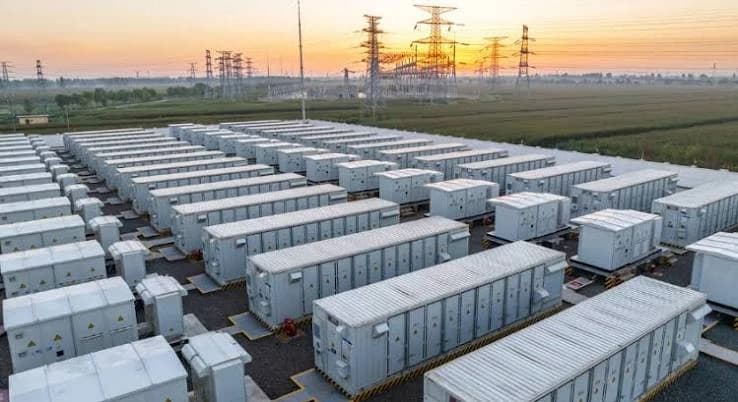
Not just an energy store.
A verified strategic investment.
OnePath BESS lets you evaluate adding a storage system to a new photovoltaic plant, one in the permitting phase, or one already in operation: it first quantifies the real economic benefit of your specific case, then accompanies the project — permitting, construction, commissioning — through to the new system's connection. No generic estimates: a complete journey that starts from your own production and consumption data.
The three main benefits
Energy arbitrage
Shift self-produced electricity in time: the battery charges when energy costs less (typically around midday, on photovoltaic surplus) and discharges when it costs more, generating extra revenue from the existing plant. An increasingly strategic way to protect your photovoltaic investment.
Self-consumption optimization
Reduces grid dependency by routing produced energy toward the facility's actual consumption, instead of selling it back to the grid at the sale price.
Backup
Power continuity in case of a blackout, sized according to your facility's actual committed power.
The simulator that quantifies your case
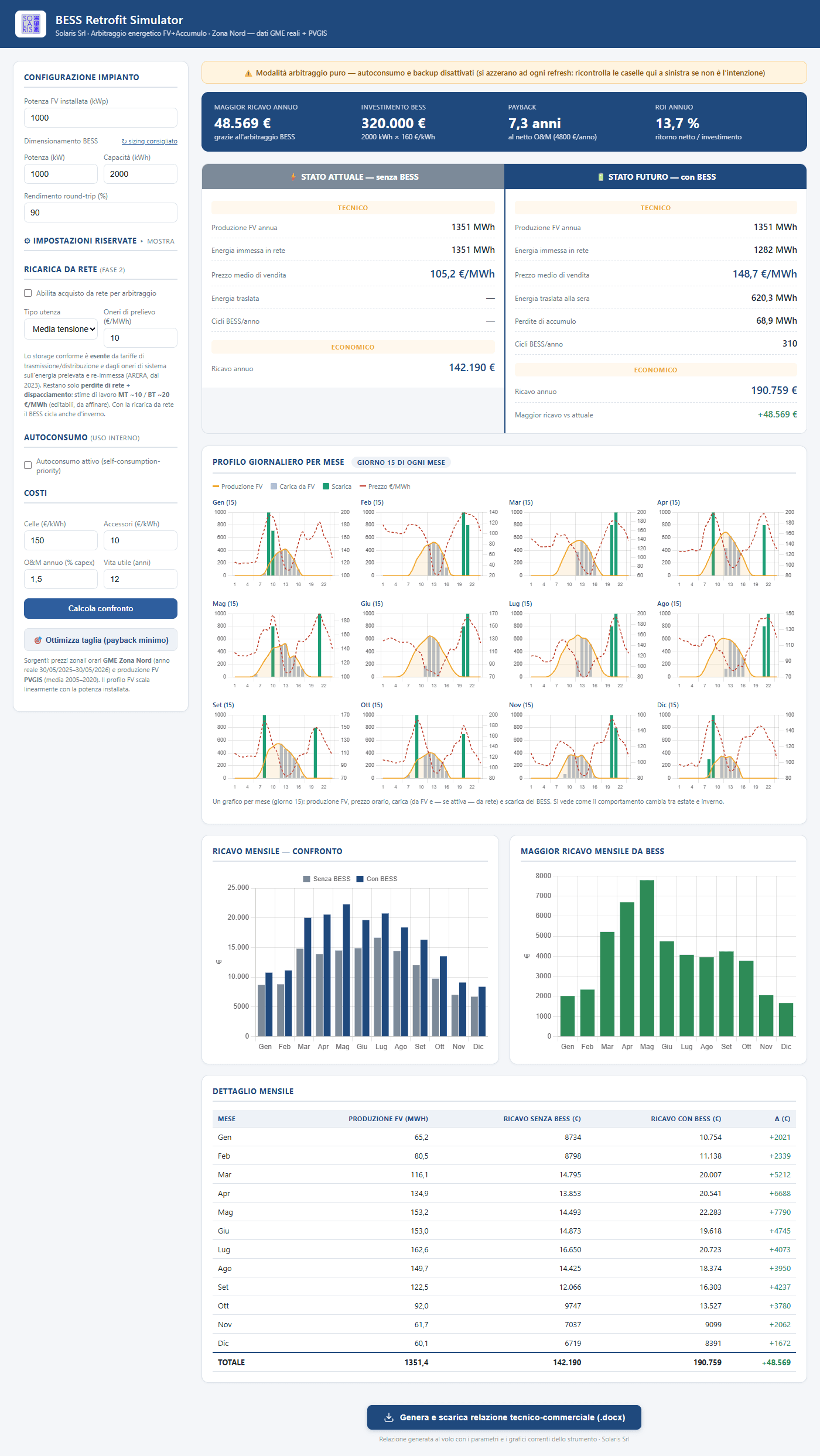
A simulator calculates arbitrage, self-consumption and backup on your actual production and consumption profile, with the optimal BESS size automatically suggested. Shown here with demonstration data.
Your project's status, always at hand
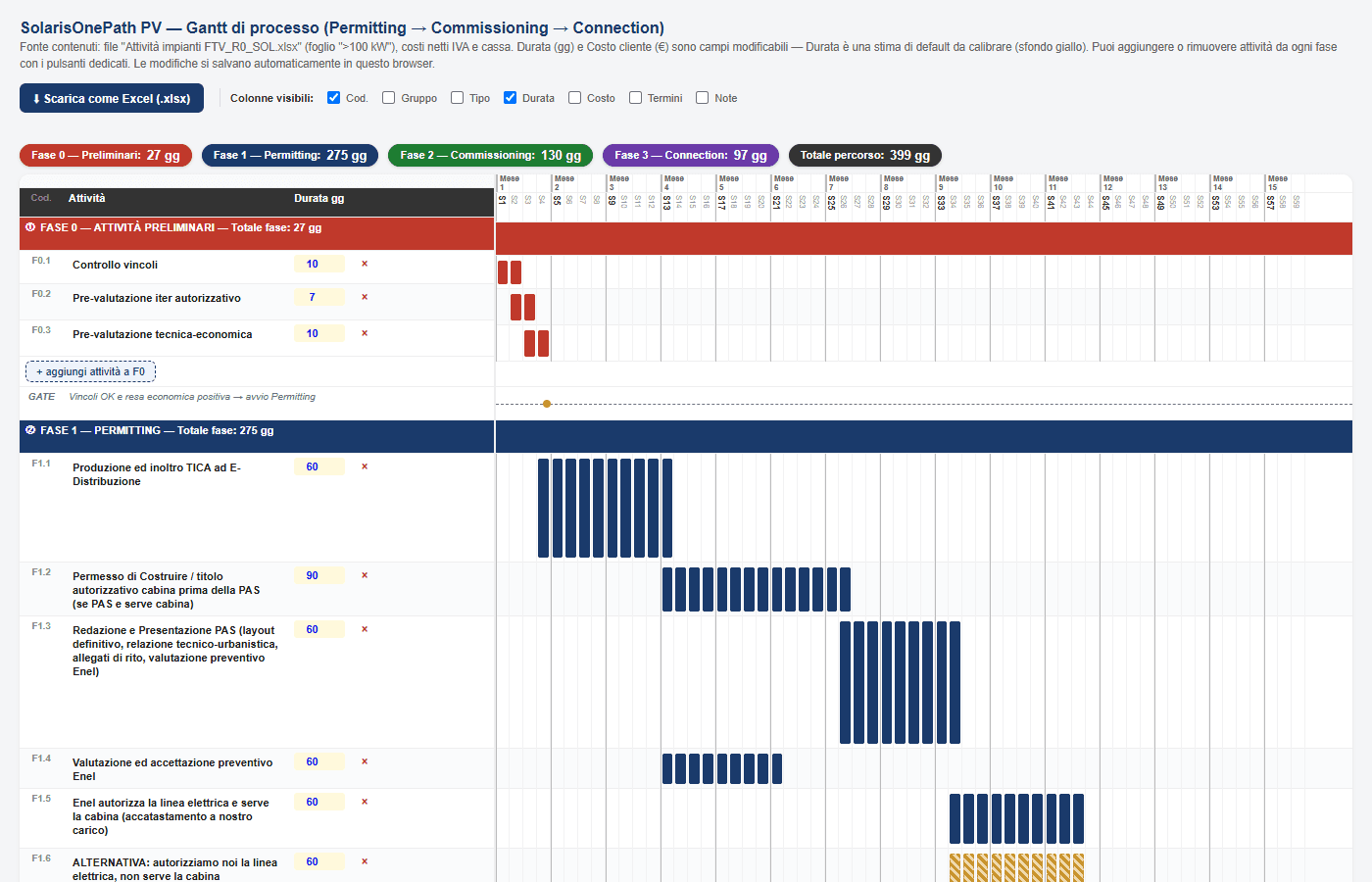
Every stage (Assessment, Permitting, Commissioning, Connection) is tracked with its activities, timelines and milestones. The client always sees where their plant stands, without having to ask.
The journey in four stages
Stage 0 — Assessment
Technical-economic analysis of the project and GO/STOP decision, before any commitment is made.
Stage 1 — Permitting
Obtaining and adjusting the authorizations needed to add the storage system.
Stage 2 — Commissioning
Design and construction of the storage system, with optimized parallel work streams to reduce overall timelines.
Stage 3 — Connection
Commissioning of the new storage system, with final testing.
Four concrete guarantees
Informed decision
Before starting the journey, a complete technical-economic business case shows investment, revenue and payback for the specific scenario (arbitrage, self-consumption, backup).
Status always visible
Your storage system's journey is tracked stage by stage: you always know where you stand, without having to ask for updates.
Permitting expertise
Permit adjustment procedures for adding storage, handled entirely by Solaris.
Complete journey
From the economic assessment to commissioning, a single point of contact for the entire project lifecycle.
Want to evaluate storage for your plant?
Request a deeper look: we'll analyze your existing plant together and give you a verifiable business case.
Request a Deeper Look